Company

Case sealing machines designed and built in İstanbul

We started out servicing imported packaging machines in 2013. Every fault we met on site was on the table when we designed our own case sealer in 2022.

Nine years inside other people's machines

Whoever repairs a machine learns its weak points faster than whoever sells it. From our founding until 2022 that was most of our work: installing imported case sealing machines on customer lines, setting them up, opening them when something failed. Different brands, different engineering answers. The complaint, though, almost always opened the same way: the machine is down and the part hasn't arrived.

That was a commercial problem, not a technical one. A spare part that takes months to arrive means, in a plant sealing cartons all day, tape pulled by hand, boxes that don't close squarely and shipments going out late. Telling a customer the part is sitting in customs buys nobody anything.

Even so, 2022 was not a start from zero. Nine years of opening machines had taught us which dimensions matter, which solutions hold up on a shop floor and which ones only look good on a drawing. That is what shaped the first design decisions.

What we saw on site set the design brief

When we sat down to draw our own machine we had nine years of service work behind us: where operators struggle with an adjustment, what has to be dismantled for a short fix, which parts get asked for again and again. Our priority list came from there rather than from a competitor's catalogue.

Installation and training are part of the job. We install the machine on the line, set it up, and show the operator hands-on how to change the tape tab and carry out daily maintenance.

A wide size window from the outset. Our machines run cartons 140-500 mm wide and 100-500 mm high, from 150 mm long upwards with no upper limit on length. The taping unit takes 38-50 mm tape as standard, with a 50-75 mm option for plants running wider tape. The fully automatic range closes 17 to 25 cartons a minute.

What happens at the Ümraniye workshop

Design, sheet-metal work, assembly, testing and service share one building in Ümraniye, İstanbul. In practice that means there is no supplier chain between the person changing a drawing and the machine that cuts the panel. It is also why custom-size machines, stretch wrappers and complete packaging lines are things we can engineer rather than quote around.

Roller conveyors and scissor-type telescopic conveyors are built in the same shop. A case sealer on its own is not a line; how a carton reaches the machine and where it goes afterwards often matters as much as the sealer itself. The product pages list all fourteen models and the conveyor options.

What stocked spares actually mean

The spare parts shelf sits next to the workshop that built the machine, not in a warehouse abroad. For a customer on the phone, that means the part is not waiting in an import queue. Service works out of the same building. You can reach us weekdays 08:30-18:00 and Saturdays 08:30-14:00; we are closed on Sundays.

Why we don't publish a price list

A case sealing machine is not bought off a shelf. The same model leaves the workshop with a different taping unit and a different conveyor arrangement depending on carton size and daily volume, so a single figure on a web page steers more buyers wrong than right. Send your carton dimensions and daily quantity through the contact page and we will put a written quote together the same day. The technical dimensions are in the catalogue as well.

2013

Founded

Disa Ambalaj was founded to work in packaging machinery. In the early years we supplied, installed and serviced imported machines, working inside dozens of different brands on site.

2022

We moved to in-house manufacturing

The recurring problem was always the same: spare parts took months and the machine sat idle. To end import dependency in packaging machinery we started designing and building our own.

Today

Fourteen models, one roof

Eight semi-automatic models, two fully automatic and four conveyors. Design, sheet-metal work, assembly, testing and service all happen at the Ümraniye facility. We also engineer stretch wrappers, complete packaging lines and bespoke machines.

Facility

Ümraniye, İstanbul

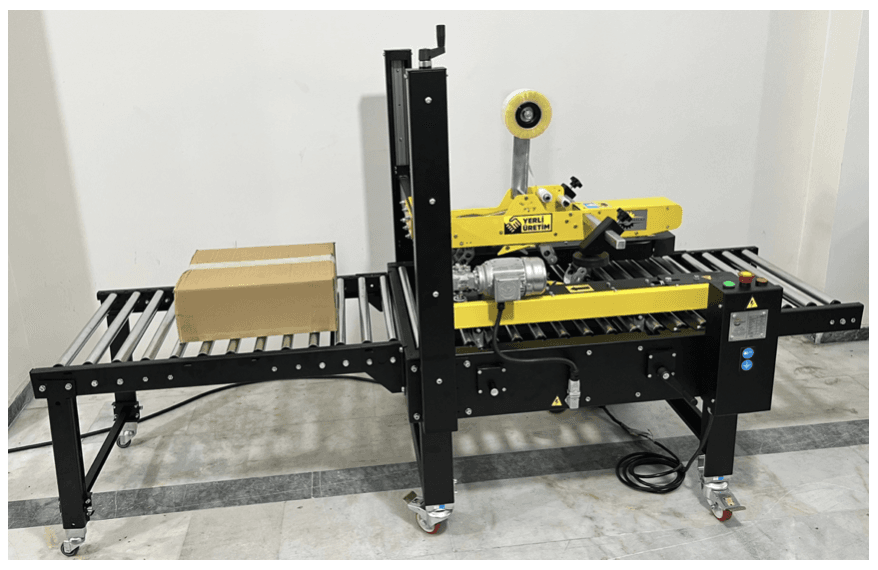
DİSA case sealer and conveyor line
Facility

Assembled, tested and dispatched from one shop floor.

Process

How an order becomes a machine

01

Carton analysis

We take your width, length, height, daily volume and current line height. If needed we run a test with your sample carton.

02

Model and quote

We agree on the model, the taping unit and any conveyor needed. Written quote, with lead time.

03

Build and test

Cutting, bending, assembly. Before dispatch the machine is run and tested with real cartons.

04

Install and train

Installation on your line, setup and operator training. Tape-tail changeover and daily maintenance shown hands on.

05

Service and spares

If something fails, the team that built the machine comes out. Spares are stocked on site.

Technical service

Would you like to see the facility?

Book a visit and see the machines running. Bring your sample carton and we will test it together.

CallGet a quote